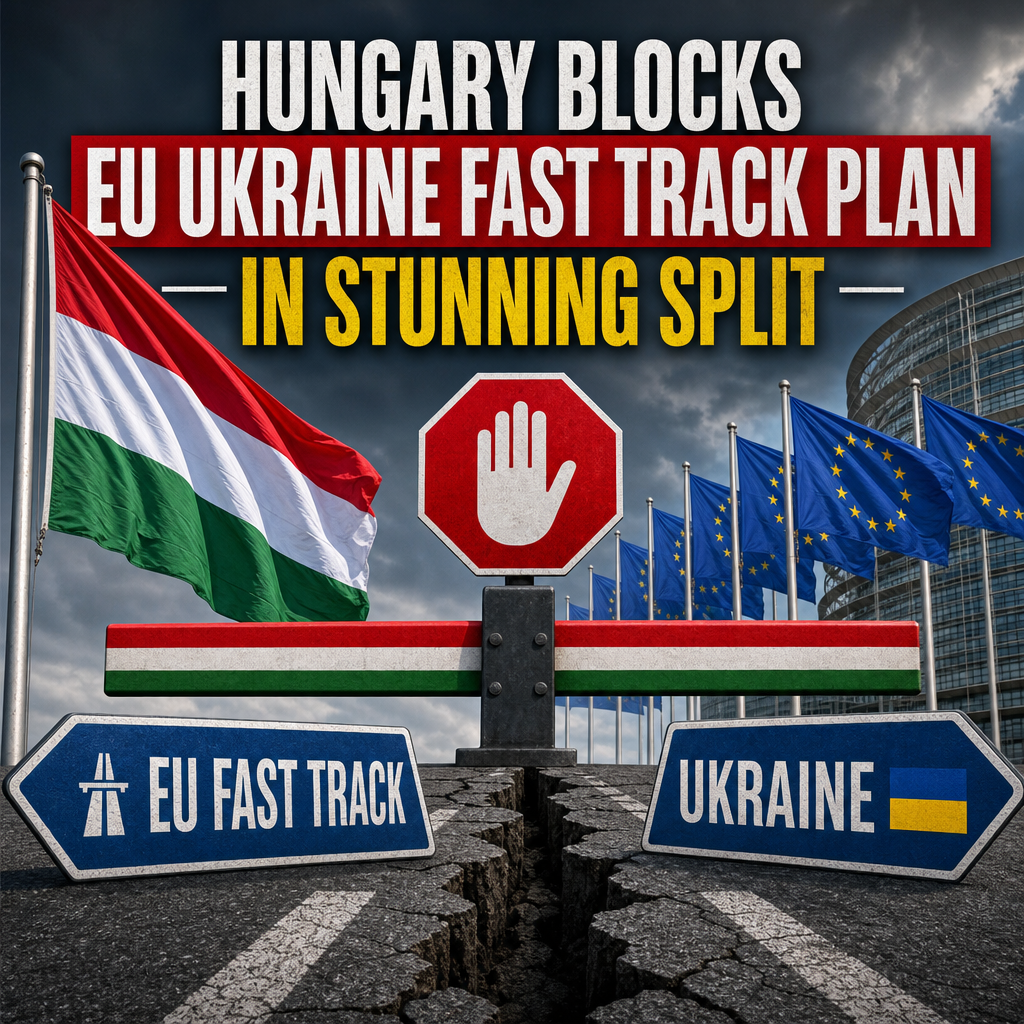
Hungary Blocks EU Ukraine Fast Track Plan in Stunning Split


Hungary’s veto has once again exposed how fragile European unity can be when Ukraine’s future is on the line. The dispute over a fast-track path for Kyiv into the European Union is about much more than procedure: it is a clash over security, sovereignty, wartime strategy, and the political limits of enlargement. While some governments see urgent membership talks as a strategic necessity, Budapest argues that moving too quickly risks importing conflict, money, and instability into the bloc before Europe is ready.
The split is significant because it comes at a moment when EU leaders have been trying to present a united front behind Ukraine. In broad terms, the message from many capitals is that Ukraine belongs in Europe and should be supported as it defends itself against Russia’s invasion. But Hungary’s position shows that consensus is far from automatic. The country has repeatedly used its veto power to slow or block measures tied to Ukraine, and this latest move reinforces the reality that EU enlargement still depends on the political will of all 27 members.



Hungary’s EU veto and the limits of unity
Hungary’s objection reflects a familiar pattern in European politics: support for Ukraine remains strong in principle, but not every government is willing to pay the same price for that support. Budapest has argued that the EU should not rush accession talks or create expectations it may later struggle to meet. That stance is often framed by Hungarian officials as prudence rather than obstruction.
At the same time, critics see something more deliberate. They argue that Hungary has turned its veto into a bargaining tool, using Ukraine-related decisions to extract leverage in Brussels. That criticism has only grown as the war drags on and EU officials push for visible signs that Kyiv’s long-term integration remains on track.




The debate is not simply about whether Ukraine deserves to join one day. It is about timing, conditions, and the balance between political solidarity and institutional caution. Enlargement is usually a slow process, built around reforms, legal alignment, and unanimous approval. A fast-track plan would not erase those requirements, but it would signal that the EU wants to accelerate the path. Hungary’s resistance makes clear that symbolism alone can trigger major friction.
Why some countries want to speed up Ukraine’s path
Supporters of faster accession talks argue that Ukraine has already paid a staggering price for choosing a European course. In their view, the EU must respond not only with weapons and financial aid, but with a credible political promise. For Kyiv, accession is not a technical side issue; it is part of the strategic struggle to anchor the country in the West and reduce the risk of future Russian pressure.
There are also practical arguments. Proponents say that closer alignment with EU standards could help Ukraine rebuild institutions, attract investment, and strengthen rule-of-law reforms. A clearer accession timeline may also reassure Ukrainians that their sacrifices have not been reduced to short-term crisis management.
But this is where the tension begins. Some EU members worry that speeding up the process could create unrealistic expectations, especially while Ukraine is still at war and large parts of its infrastructure and economy remain under strain. Enlargement fatigue is real in parts of Europe, and governments facing domestic political pressure are increasingly sensitive to voters who question whether the bloc can absorb another major member so soon.
The competing concerns behind the split
Across the reporting from international outlets, three broad viewpoints stand out:
– Pro-Ukraine urgency: Kyiv needs a credible European path now, not after years of drifting.
– Institutional caution: The EU should not weaken its enlargement standards or overpromise.
– Political hardball: Hungary may be using the issue to assert leverage inside the bloc.
That mix explains why the argument has become so heated. It is not merely about one country’s application; it is about whether the EU can act as a geopolitical actor when members disagree.
What the stalemate means for Ukraine and the EU
The immediate consequence of Hungary’s move is uncertainty. Even when the bloc broadly supports Ukraine, a single member can slow the machinery down. That matters because accession is as much about credibility as it is about law. If EU leaders repeatedly signal that membership is possible but cannot deliver movement, the promise risks losing value.
Still, it would be a mistake to overstate the meaning of one veto. EU diplomacy often advances in stages, with delays followed by compromise language, side agreements, or revised timetables. Hungary’s block may frustrate Kyiv and alarm its supporters, but it does not necessarily end the process. More likely, it forces a harder round of bargaining over how to keep Ukraine’s accession track alive without tearing apart internal EU consensus.
For Ukraine, the episode is a reminder that European integration is not just about battlefield resilience or public sympathy. It also depends on enduring political alignment among member states with different priorities, histories, and domestic pressures. For the EU, the episode raises a bigger question: can the bloc expand and remain effective if unanimity allows one government to stall the collective will?
The honest answer is that no clear resolution is visible yet. Hungary’s position has sharpened the divide, but it has also exposed something the EU can no longer ignore. The longer the war continues, the more Brussels will be forced to decide whether it wants enlargement to be a strategic instrument or merely a distant aspiration. For now, the split shows that on Ukraine, unity is still real—but not guaranteed.